In the selection of mechanical and electrical products, structural design is often one of the key factors determining overall machine performance. Compared with the traditional inner rotor configuration, outer rotor motors exhibit irreplaceable advantages in various industrial applications due to their unique mechanical layout. An in-depth analysis of their structural design helps engineers better understand the applicability of these motors under different working conditions.
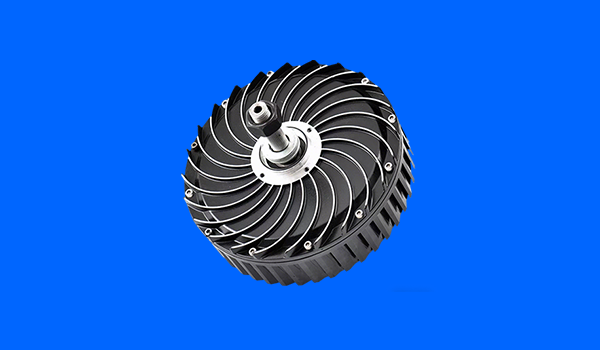
The overall structure of an outer rotor motor consists of three core components: a fixed shaft, an internal stator, and an external rotating housing. The stator core is made of stacked high-permeability silicon steel sheets, embedded with multi-pole copper windings, and directly fixed to the central shaft. The rotor is composed of a ring-shaped permanent magnet and a metal housing; the magnets are glued or embedded on the inner wall of the housing, which serves as both part of the magnetic circuit and the power output end. This external rotation & internal stationary layout fundamentally differs from that of inner rotor motors.
In terms of structural design advantages, the first notable feature of outer rotor motors is their extremely short axial length. Since the rotor directly wraps around the stator in a cylindrical shape, no additional bearing seats or couplings are required for torque transmission, greatly reducing the overall length. This is highly significant for equipment installed inside fan blades, hubs, or limited flat spaces. For example, in axial fans, the impeller can be directly mounted on the housing, realizing an integrated design of the motor and impeller.
The second structural advantage is a large moment of inertia. The mass of an outer rotor motor is mainly distributed at the outer edge of the housing with a larger radius, ensuring excellent rotational stability and minimal speed fluctuation during low-speed operation. Meanwhile, the larger moment of inertia prevents the motor from losing synchronism or stalling under sudden load changes, making it especially suitable for applications requiring frequent start-stop operation or inertial loads.
The third feature is the natural rationality of its heat dissipation structure. The stator winding, the main heat source of the motor, is fixed to the central shaft, allowing heat to conduct through the shaft to the mounting bracket or heat sink. At the same time, the rotating housing drives surrounding airflow like fan blades, providing forced air cooling for the stator. This self-cooling capability enables outer rotor motors to withstand higher current densities within the same volume.
Furthermore, the structure of outer rotor motors results in low noise operation. Without a gear reduction mechanism, the motor directly drives the load, eliminating gear meshing noise. Additionally, the cylindrical housing features high rigidity, effectively suppressing the transmission of electromagnetic vibration to the outside.
Naturally, this structural design also has certain limitations, such as high requirements for housing dynamic balance and relatively complex sealing and protection. However, in most applications pursuing compactness, low-speed high torque, and low noise, the structural advantages of outer rotor motors remain an irreplaceable primary choice. A proper understanding of these design features helps make more scientific decisions during product selection.



 Fax:0512-58592061
  E-mail:ZhangW@jiujiujiayi.com.cn
  Add:No. 18, Xinjing Middle Road, Yangshe Town, Zhangjiagang City, Suzhou City, Jiangsu Province