In various electromechanical devices, the selection of power output devices directly affects the overall performance. As a special type of motor structure, outer rotor motors have gradually become core driving components in fans, home appliances, and light electric vehicles due to their compact axial size and unique torque output characteristics. To understand their advantages in many applications, we must first analyze their distinctive working principle in depth.
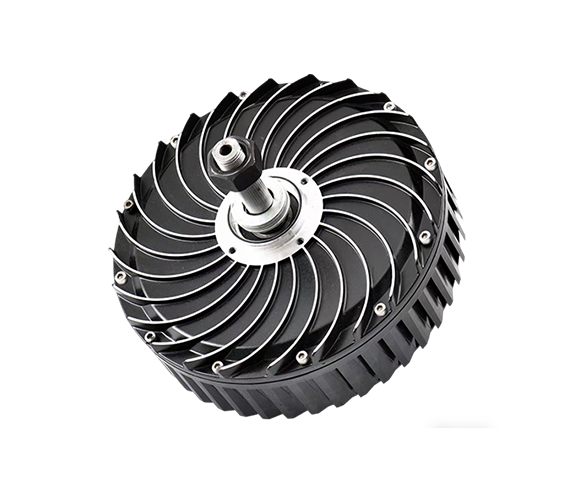
The core feature of an outer rotor motor is its "reverse" structure. Unlike traditional inner rotor motors, it does not rotate the inner shaft; instead, the outer casing acts as the rotating part. Electromagnetically, the motor mainly consists of an inner stator and an outer rotor. The stator is made of laminated silicon steel sheets with multiple coils wound around it, fixed on the central shaft and kept stationary. The rotor is composed of high-energy-product permanent magnets attached to the inside of the cylindrical housing.
When the outer rotor motor is connected to a three-phase AC power supply (or DC power via a driver), alternating current flows through the stator windings. According to Faraday's law of electromagnetic induction, the current in the stator coils generates a rotating magnetic field. This field acts on the outer permanent magnet rotor through the air gap rather than through mechanical contact. Driven by the magnetic principle that "opposite poles attract and like poles repel", the rotating stator magnetic field pulls the magnetic poles of the rotor permanent magnets.
Since the stator is fixed on the shaft and cannot move, while the rotor (along with the housing) is unconstrained, the electromagnetic torque drives the entire housing to rotate. Simply put, the "virtual magnet" generated by the stator rotates internally and carries the "real magnet" of the housing along with it. This direct-drive method eliminates complex intermediate transmission mechanisms such as gears and belts.
This working principle brings significant technical advantages to outer rotor motors. First, because the moment of inertia is concentrated at the edge of the housing, it runs extremely smoothly, especially in low-speed, high-torque scenarios. Second, the heat generated by the stator coils is more easily conducted through the fixed central shaft, and the fan effect created by the rotating housing further assists overall heat dissipation.
In practical applications, whether it is the quiet spin-drying of direct-drive washing machines or the gentle airflow of industrial fans, the outer rotor motor efficiently converts electrical energy into mechanical energy based on the principle of electromagnetic induction. Understanding this principle helps engineers more accurately determine its suitability for working conditions requiring high torque, low speed, and limited installation space. With continuous improvements in the performance of permanent magnet materials, the application scope of outer rotor motors is further expanding.



 Fax:0512-58592061
  E-mail:ZhangW@jiujiujiayi.com.cn
  Add:No. 18, Xinjing Middle Road, Yangshe Town, Zhangjiagang City, Suzhou City, Jiangsu Province