In modern industrial and automated drive applications, permanent magnet synchronous motors (PMSMs) are gradually becoming the core choice for high-efficiency transmission. To understand why they are so widely favored, we first need to grasp their basic working principle. The rotor of a PMSM is directly embedded with high-performance permanent magnets, which generate a constant magnetic field without requiring excitation current. When three-phase symmetrical alternating current is applied to the stator windings, a rotating magnetic field is produced. This field interacts with the permanent magnetic field on the rotor, generating synchronous torque that drives the rotor to rotate at the same speed as the rotating magnetic field. Since the rotor speed always matches the synchronous speed of the stator magnetic field, it is called a “synchronous motor”.
Compared with traditional electrically excited synchronous motors, the greatest structural advantage of PMSMs lies in the elimination of excitation windings, slip rings, and brushes. This simplification not only reduces energy loss by removing excitation losses but also greatly improves system reliability and ease of maintenance. No current flows through the rotor, so no rotor copper loss occurs, resulting in a flatter overall efficiency curve for the motor, maintaining high efficiency even under light-load conditions.
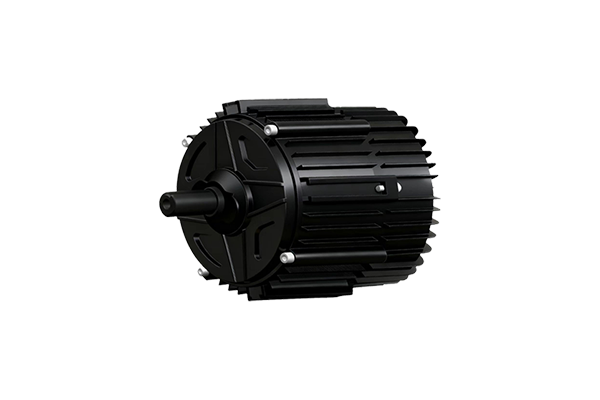
In terms of internal structure, a PMSM mainly consists of a stator, rotor, end covers, and other components. The stator is similar to that of a common asynchronous motor, with multi-phase symmetrical windings embedded; the core of the rotor consists of carefully arranged permanent magnets. According to the mounting position of the magnets, there are two common structures: surface-mounted and interior-mounted. The surface-mounted type features a simple structure and easy control, suitable for applications requiring high dynamic response. The interior-mounted type utilizes reluctance torque, offering better flux-weakening speed expansion capability and higher mechanical strength.
In addition, PMSMs are distinguished by their high power density. Thanks to the strong air-gap magnetic flux provided by permanent magnets, they can deliver greater torque and power than asynchronous motors of the same volume and weight, allowing for more compact and lightweight equipment design. Meanwhile, with no slip ratio, the speed is strictly synchronized with the power frequency, making them excellent in precision position control and multi-motor synchronous drive systems. Overall, understanding the working principle and structure of permanent magnet synchronous motors is fundamental to correct selection and efficient application.



 Fax:0512-58592061
  E-mail:ZhangW@jiujiujiayi.com.cn
  Add:No. 18, Xinjing Middle Road, Yangshe Town, Zhangjiagang City, Suzhou City, Jiangsu Province